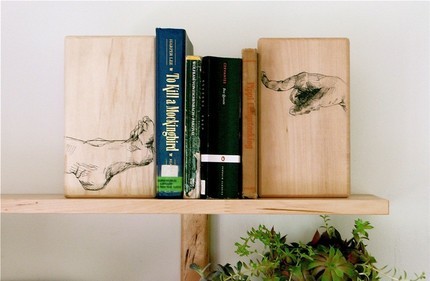
5″ by 9.5″ by 3″ unfinished solid wood blocks with original pen drawing of a foot and hand by Auroralee Hales and available in her Etsy shop.

5″ by 9.5″ by 3″ unfinished solid wood blocks with original pen drawing of a foot and hand by Auroralee Hales and available in her Etsy shop.
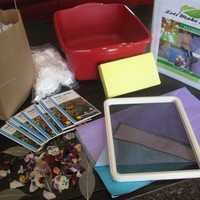 One of my bookmaking kits got a nice mention on the Etsy Blog today, in an article about “crafting adventures with paper.” They mention some things that I didn’t include in my recent post on bookmaking supplies and tools on Etsy. Like the Plantable Paper Kit Deluxe from Good Karma Soaps pictured (“plantable paper” is “tree free” paper made using unwanted paper and embedding wildflower seeds. The idea is to plant the paper when you’re done with it and the wildflowers will grow.) as well as stuff for printing (like Gocco kits) and handmade paper. Take a look here.
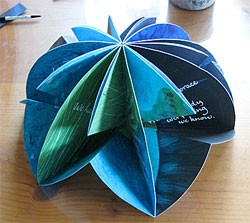 It’s been very grey here in the mornings; summer is over too early (at least for me). But I was cheered up when I had a chance to take a look at Cari Ferraro’s prototype for a circlular book. The colors are great, and she’s got more pictures to show one section, so do have a peek at her blog. It’s been very grey here in the mornings; summer is over too early (at least for me). But I was cheered up when I had a chance to take a look at Cari Ferraro’s prototype for a circlular book. The colors are great, and she’s got more pictures to show one section, so do have a peek at her blog.
|
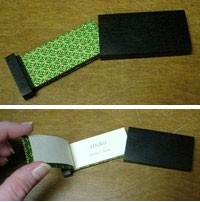 This week is the Miniature Book Society’s Grand Conclave — their annual conference for those little (under 3 inches) books. I checked out their website & they have nice PDF catalogs of their annual competitions. The winner from 2008 is to the right. It’s called Haiku by Stephen Byrne, and the catalog says “16 pp. 1-7/16” x 2-3/8”. Edition of 15 books. Letterpress printed, on Japanese paper. The book consists of haiku which were inspired by sights seen on country walks. The text block is bound into the lid of the ebony box which houses the book.” Past entrants have made some pretty spectacular 3D books, with popups and tunnel books and wiggly long accordions…
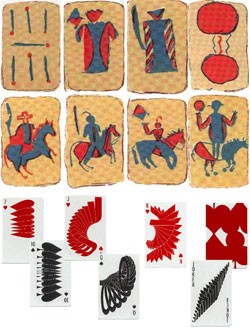 Ever since I printed a set of playing cards in collaboration with my friend Mary Jane, I’ve been interested in other designs. The colour lovers blog had a post the other day combining lots of card images with their history. One thing they don’t mention is how much card playing grew after the invention of the printing press, which made it easier to produce the decks. Ever since I printed a set of playing cards in collaboration with my friend Mary Jane, I’ve been interested in other designs. The colour lovers blog had a post the other day combining lots of card images with their history. One thing they don’t mention is how much card playing grew after the invention of the printing press, which made it easier to produce the decks. |
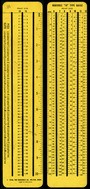 In my letterpress classes I am constantly reminding students to use a ruler or pica pole to measure things — Is the type straight on the page? Is it really centered? How much furniture do they need for the lockup? Some resist (although everyone comes around by the end of the day), but others start immediately to reminisce about using a type gauge, like the Haberule ones on the left.
 I looked up the Haberule the other day, to see if perhaps I could find one to show students. I immediately found the Museum of Forgotten Art Supplies, full of tools that were useful not-so-long-ago, but have been mostly supplanted by computers. Look here for info on the Haberule (be sure to look at the comments, which explain how it works).