Poets making books

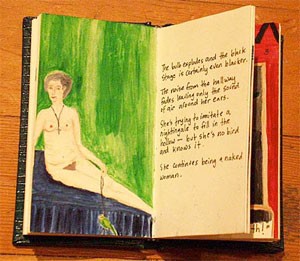
Denise Newman’s bookAs a follow-up on my recent post on Jeannine Stein’s thoughts on what bookmaking means to her, I’ve been looking for comments by other bookmakers. I ran across a set of interviews from 2000, in the journal How 2 called Livres de Poètes: Six poets talk about the books they make. The interviewer, poet and book artist Dale Going, says: "In co-curating, with Jaime Robles, an exhibition in June 2000 at the Berkeley Arts Center called Livres de poètes (femme), I’ve had the pleasure of reading, handling, looking at, experiencing about a hundred such handmade books by poet/book artists whose work balances on the textual/visual cusp. I talked with six artists whose work covers a range of methods, techniques, and intentions." (entire intro to the interviews here.) The poets/bookmakers she interviewed are:

Lisa Kokin (her website)
"I don’t just make books: I also make sculpture and installation art…"

Emily McVarish (more of her work)
"I’ve been really interested in the three-dimensional and mechanical aspects of reading and poetics…"

Denise Newman
"I began making books over a series of summers spent writing on the Danish island of Bornholm…"

Eléna Rivera (website with her poetry)
"I used to write and make books as a child, so for me, making letterpress books was a rediscovery of book making…"

Jaime Robles (read some of her poetry)
"I started working with books when I was fairly young; in college I majored in both English and art…"

Meredith Stricker (one of her books, Alphabet Theater, and see part of the book on GoogleBooks)
"Thinking about my own history of writing, it has become clear to me that it’s not that there was poetry and then there were books; the materials and objects were the poetry…"
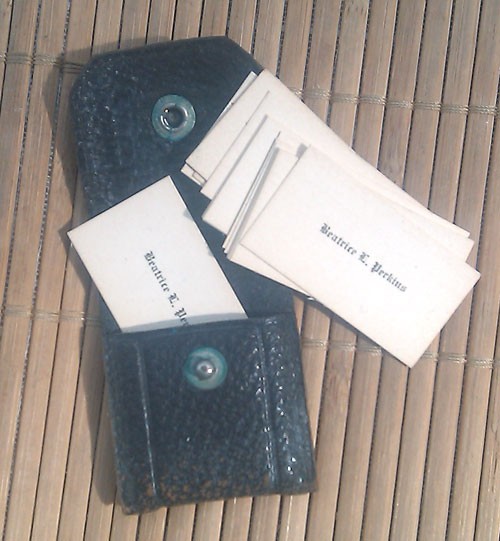
Beatrice’s Life, $10

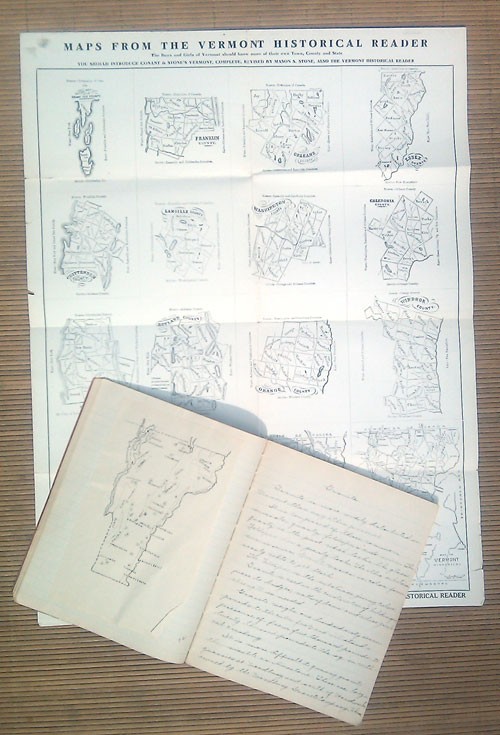
I’m still in Vermont, and while we’ve been here, no matter where we go, my sister seems to want to stop at every antique shop, barn and garage sale along the way. I must confess there’s usually nothing of interest for me, but much that would suit her Victorian-era house. In particular she’s been looking for some extra chairs for her dining room as well as frames for some old maps she’s acquired. Yesterday we went to a large estate sale and had an unexpected find, something even I was enamored with! It was a small pile labeled “Beatrice’s Life, $10” and included 3 large, framed diplomas, several photographs of Beatrice, and what looked like a school workbook. While my sister examined the frames, I idly picked up the book — and out fell a folded piece of paper and a small leather pouch. The workbook, with the title page “History of Vermont, ’26,” was full of beautiful handwriting and hand-drawn maps of Vermont. The folded piece of paper turned out to be a series of maps of Vermont.

Beatrice’s Life

As my sister pulled out the tape measure to check the frame sizes, I opened the little pouch. It measures 2×1-1/2″ and contains tiny calling cards (1-5/8×7/8″) with just a name on them.

Beatrice’s cards

The frames were just what my sister was looking for, so off we went with the whole package. Once we got back home, I examined the workbook in detail. At the bottom of the large map, it says “The Sheet and County of State Maps for blackboard exercises, taken from the NEW VERMONT HISTORICAL READER furnished free with every copy of the book… Every pupil should have one. The sheets can be mounted on cardboard or enlarged by the scholar. The teacher can require villages, mountains, roads, etc., to be marked in each town, so as to get the pupil familiar with his own locality county and state.” The workbook, dated 1926, was the result of these blackboard exercises. The New York Public Library has digitized the 1903 version of The Vermont Historical Reader And Lessons on the Geography of Vermont, with Notes on Civil Government.
Of the diplomas in the frames — one was for finishing an advanced course of the Palmer Method of Business Writing, where she was awarded a “Certificate for Superior Ability in Rapid Muscular Movement Commercial Penmanship.”
A Bookish Life

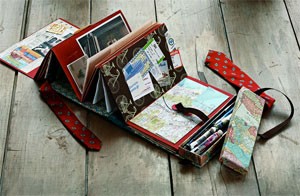
One of Jeannine Stein’s travel booksThere’s a nice article in the LA Times by book artist Jeannine Stein about what bookmaking means to her. Stein is the author of Re-Bound: Creating Handmade Books from Recycled and Repurposed Materials and Adventures in Bookbinding: Handcrafting Mixed-Media Books. That’s one of her travel books to the left (photo by Glenn Scott / Quarry Books). The article starts off

I made my first book about 17 years ago, a feat I consider a miracle. On a whim I took a class on making cased-in books with hard spines, and when I looked at the finished product I was astounded, as if I’d made a car with my bare hands.

Tilt-Shift Photography

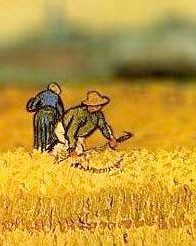
Tilt shift van goghI’ve used a fair amount photography and some paintings in my books, and I thought tilt shift photography might be something to explore, especially since I can simulate it in Photoshop. Wikipedia defines the technique as “the use of camera movements on small- and medium-format cameras … often for simulating a miniature scene” — in other words it gives a real-world scene the illusion of being a miniature model. The detail to the left is from a set of Photoshop manipulations of paintings by Van Gogh. Look here for examples of photographs. There’s a Photoshop tutorial here, and this Google search will get you even more.

Stone on Stone

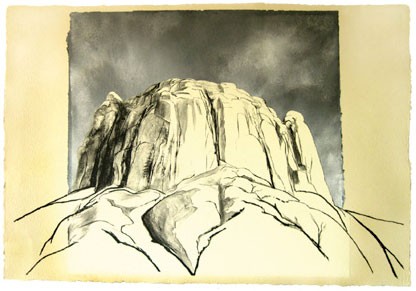
Clair Van Vliet, Ghost Mesa

Several of my books use structures I learned from Vermont book artist and printmaker Claire Van Vliet (from classes with her as well as her book Woven and Interlocking Book Structures). So when I heard there was a small exhibit of her work close to my sister’s house in Vermont, where I’m staying for the month of August, I made it a point to go take a look. Much to my surprise and delight, on exhibit were lithographs of stones, most of them outside Abiquiu, New Mexico, near my own home. The one above is called “Ghost Mesa” and is close to Ghost Ranch, where Georgia O’Keefe lived and painted, and about an hour from my house in Santa Fe. (The exhibit was called “Stone on Stone,” as they are stone lithographs of stone outcroppings.)
I found an interesting interview with Van Vliet by Bob Bahr — Van Vliet’s Rocks — where she talks about why she often uses stones and rocks in her work.

Claire Van Vliet, a veteran printmaker and an acclaimed art-book printer and publisher, loves to draw rocks. “Drawing rocks gives you a really good excuse to make a picture that is just pure form, without a literal history,” she says. “When I start, the form catches my imagination — the shape of the rock is what catches my eye. I’m not looking for anything specific. That’s why I like to work with something abstract like a rock. I’m just looking, seeing.”

You can see more of Van Vliet’s lithographs here.