
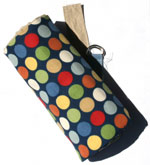
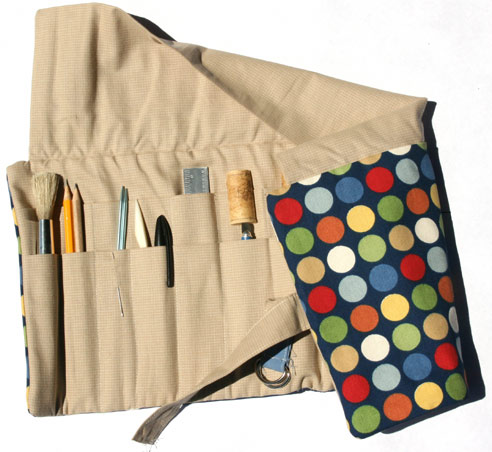
 Jamye Jamison, a paper conservator here in the Bay Area, has a roll-up soft-sided case for her tools (bone folder, scissors, x-acto knife, brush, pencil, ruler…) that I covet. I use a zippered pouch for my own tools, but I have to dig around in it to find anything (and sometimes get poked). Jamye got her roll-up as a graduation present and it was made specifically for her, with bright fabric on the outside. She thought a roll-up case for knitting needles might work, so I looked on Etsy and found this case from Sarah Kincheloe. The inside is made of soft cotton and the outside is canvas. It has batting inside to protect my tools and a flap at the top to keep them from moving around when the case is rolled up. And the fabric is bright and cheery and makes me happy every time I unroll it.
 I
I 
 I guess that’s an ok definition, but a few pictures would help. While there are lots of pictures on the web and lots of books available, I particularly like Sarah Bodman’s book