How To: Turkish Map Fold

opening3.jpg

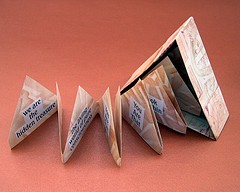
I’ve used this folding technique for my book Summer as well for a book I did as part of my on-going prompt challenge, shown in this blog post. David Rosen taught me this fold. He had instructions on his website, but they (and it) have disappeared.
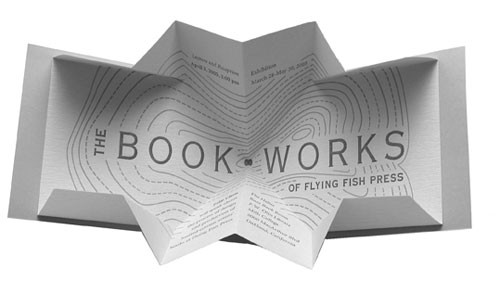
The photo above shows an example of the fold (an invitation to an exhibition of works by Julie Chen.)
Directions for the fold are here.

UPDATE: Click here to see other posts on the Turkish Map Fold and its variations.

Bookwheel: Getting Organized

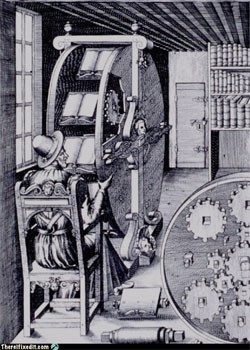
Agostino Ramelli’s BookwheelProbably 90% of people who make New Year’s resolutions include “get more organized.” This may be the first January in quite some time that I didn’t try to “fix” some mess in my office and studio by rearranging things. Probably because I did a complete overhaul last September when I bought another set of paper drawers. But increasingly it’s information overload, not stuff, that’s a problem for me. Apparently this it’s a new problem, as reported by There I Fixed It, in a post called “Historical Thursday: Agostino Ramelli’s Bookwheel.” They say

The 16th century saw a similar wealth of knowledge increase. With the recent(ish) invention of the printing press, individuals now had access to a much wider variety of books and a fraction of the price. For the first time ever, it was viable for a person to have a library in their own home.
But imagine yourself back then attempting a research project. You want to learn about a topic from multiple sources and cross-reference each one. A desk with a scattered pile of books in no logical order with all sorts of bookmarks and notes trying to make sense of it all. Agostino Ramelli, an Italian engineer born in 1531 proposed a complex but intriguing solution to this problem; the bookwheel.
Based on the design of a waterwheel, the bookwheel would hold over a dozen separate titles, all sitting open at the same angle. Using either hand or foot controls, the reader could easily sort through the books he collected at ease without the fear of losing track of his place.

Read it all here. First seen on boing boing.

Prompt Challenge: Truss

I’ve challenged myself this year to use a different word each week (the word featured each Monday on dictionary.com) to get me into my studio and developing some new ideas. My first word was truss. I thought that if nothing else came to mind, I would use the meaning “to tie, bind, or fasten” to sew an interesting binding on a blank book. I wondered if I could use whatever pattern one might use to truss a chicken. But a Google image search for truss brought up only pictures for the engineering or architectural meaning: “any of various structural frames based on the geometric rigidity of the triangle,” in particular for bridges.
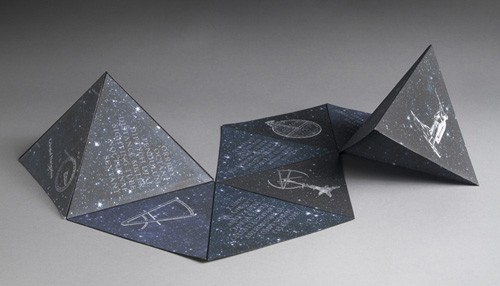
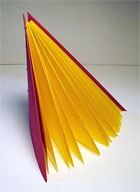
Pyramid Power: the hinged triangle book from Karen Hanmer

This lead me in search of book structures with triangular pages. The one above is an elegant triangle book by Karen Hanmer (She has a lovely gallery of her work on her website.)

Dennis Yuen’s triangle book Daily Threads Origami Triangle book

Or, on the left, Dennis Yuen’s book with triangle pages and coptic binding. Right is an accordion triangle book by Lolita of Daily Threads.

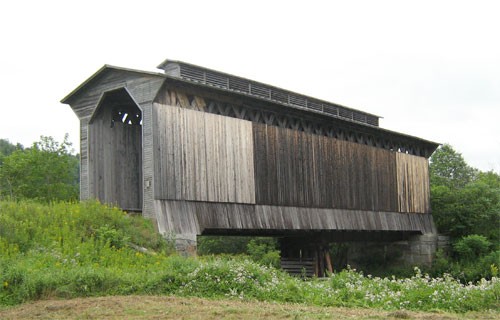
Fisher Covered Railroad Bridge, Vermont

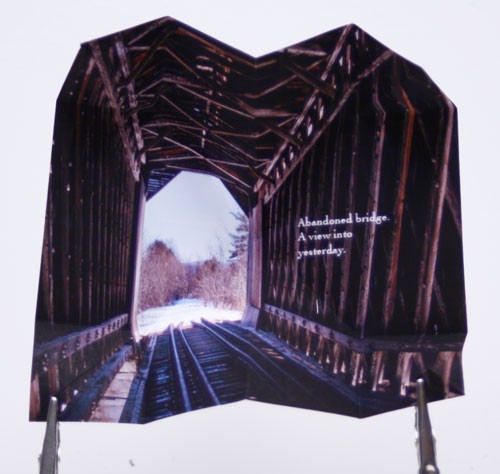
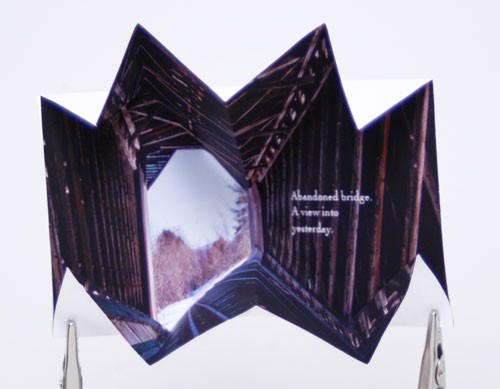
But as I stood at my bench making models of triangle books, I kept thinking about the covered bridges I visited in Vermont this past summer. Especially the one above close to my sister’s that was unusual for being a railroad covered bridge. And a haiku I had written about the bridge

Abandoned bridge.
A view into
yesterday.

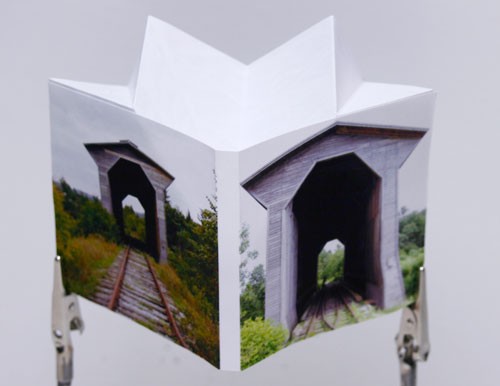
That’s when I hit on the idea of using a turkish map fold (more on how to do this fold later this week), which involves triangles. And I was lucky enough to find photos online of views looking into and out of the bridge (of course the pictures I took were only of the outside!) Here’s the results:
truss-1.jpg
Partially open

truss-3.jpg
Fully open

truss-2.jpg
the back and front covers

The word for next week: heterotelic, adj. Having the purpose of its existence or occurrence apart from itself.

Prompt Challenges

The Exquisite PromptRecently I ran across a phrase new to me, prompt challenge, on this blog. The “challenge” is to create something based on a regularly scheduled prompt or idea. I poked around and found some other challenges

I’m sure there’s lots more…. I’ve been thinking I’d like to motivate myself to do a quick something each week. So every Monday I’ll use the “word of the day” on dictionary.com to inspire a book, haiku, collage …. for that week. The following Monday I’ll post a picture of whatever I’ve done. Hopefully I can keep it up most of the year!
If you’d like to play along, the first word is truss, to tie, bind, or fasten. There are more meanings here, for instance, in horticulture it means “a compact terminal cluster or head of flowers growing upon one stalk.”