 Haiku seems to be popping up all around me this summer and keeping me on track with my off-again-on-again practice of writing a haiku a day. Most of the ones I wrote through the end of July were about the lack of rainfall here in New Mexico & my very dry garden.
the sky grows dark.
thunder. lightning.
not a raindrop falls.
Once I got to Vermont, where it is very wet (rain every other day, and my sister’s house is surrounded by lakes and ponds), water became the recurring theme.
far across the lake
a loon’s cry.
cattails at attention.
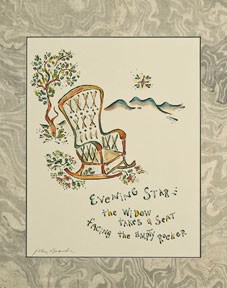
While in Vermont, I attended a reading given by David Budbill, whose poetry is very haiku-like. Then last week I went to the opening of From a Distant Road, an exhibit at the Museum of New Mexico that includes John Brandi’s contemporary haiga (haiku poems accompanied by brush art work). That’s an example above, and click on it to see more of his pieces from the exhibit.
 Brandi gave a talk before the reception, introducing us to the history of haiga. But most interesting to me were his comments on his practice of writing haiku — that it was often about encapsulating an “aha” moment or that he sat outside and wrote about what was happening around him. I usually write at the end of the day and use it to reflect back on what took place that day, with my generally imperfect memory.

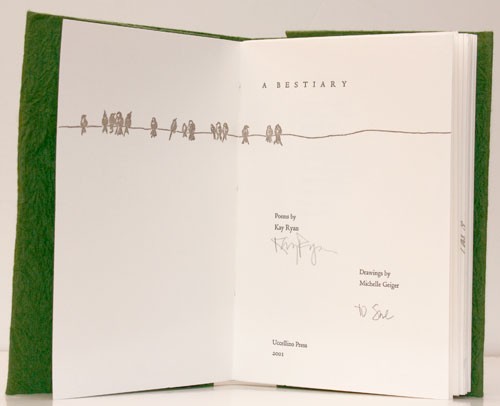
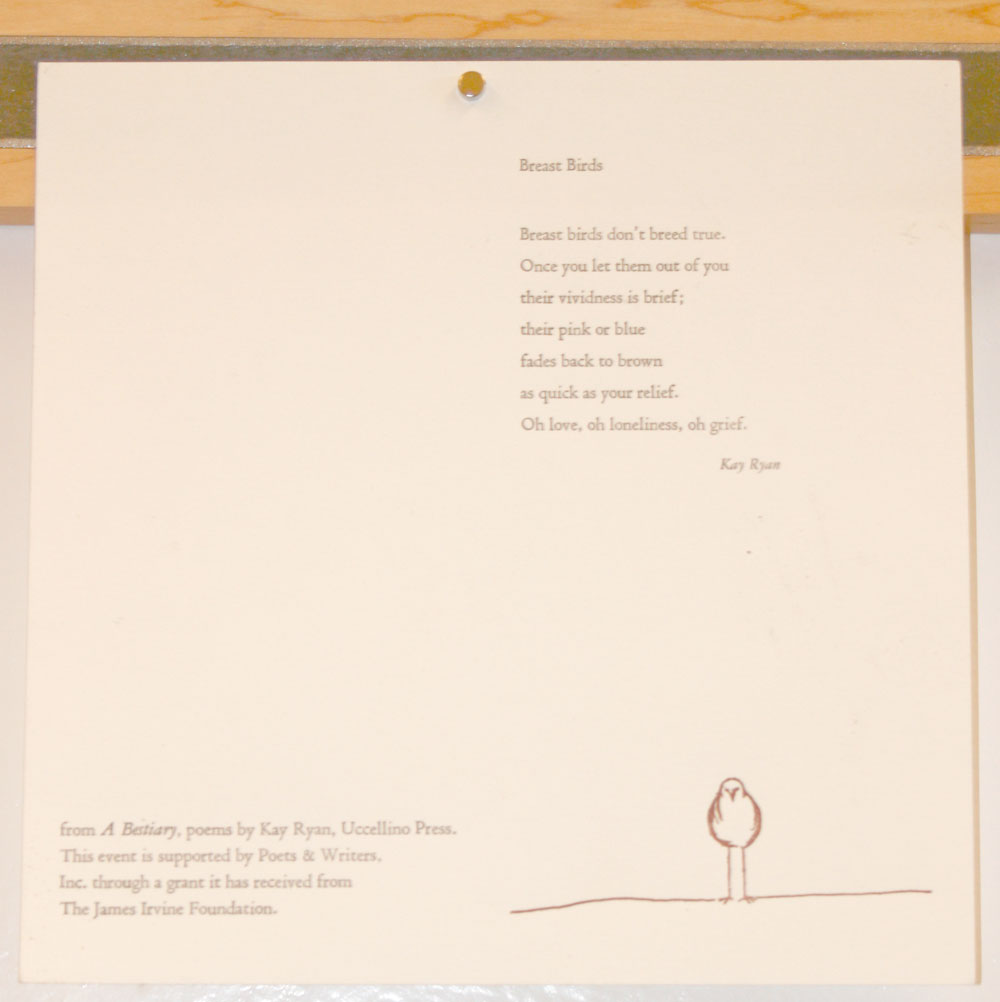 It’s been a long time since I posted a book in my artist’s book collection. Then the other day I read that the poet Kay Ryan had gotten a MacArthur Fellow Genius award. I have a broadside from a reading she did at the SF Center for the Book in 2001 hanging near my own press (that’s it to the left — click on it to get a larger image and read the poem). Ryan had allowed the Center to use her poetry in a book produced by a year-long letterpress class — the text is in Centaur, set by hand, and the drawings, by Michelle Geiger, were done in photopolymer. I also have a copy of that book, which I happily re-read. The title page is shown below.