Cover Browser

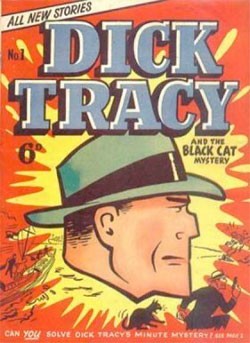
Cover from Cover BrowserOne of the best things about the web is that people share their collections. Like Cover Browser, over 455,613 covers from 2,923 different series of (mostly) comic book covers. I like that the type and colors on these covers fairly screams at you to read the books inside.

Unseen Hands

Unseen Hands: Women Printers, Binders and Book DesignersLast weekend I stumbled upon an online exhibit from Princeton University Library’s Graphic Arts Collection called Unseen Hands: Women Printers, Binders and Book Designers. The introduction to the exhibit starts

Women have been involved in printing and the making of books ever since these crafts were first developed. Even before the advent of movable type, there was a strong tradition of women producing manuscripts in western European religious houses. In the Convent of San Jacopo di Ripoli in Florence, we find the first documented evidence, in 1476, of women working as printers. Girls and women were often trained by their fathers or husbands to assist in printing businesses, and there are many instances from the fifteenth to the eighteenth centuries of women taking over and managing these enterprises upon the early demise of their male relatives.

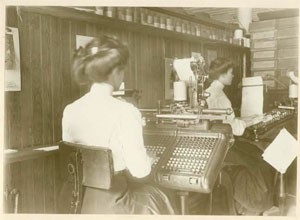
It’s nicely arranged — you can look at the women featured by name, occupation, thumbnails of their work or on a timeline. Links lead you to a short summary of each woman’s work and more pictures.
Pictured above, women setting type at a monotype machine at the Riverside Press, Cambridge, 1911 (seen here).

Typography and Lettering Books

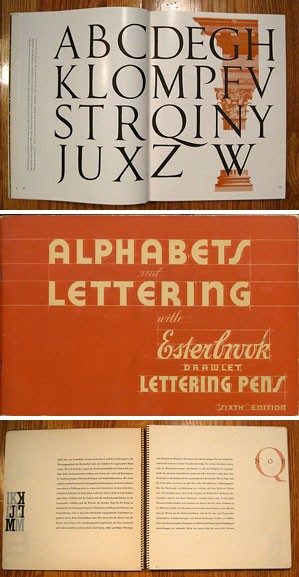
Type and Lettering Books on FlickrThe other day Doug Wilson mentioned on his blog that he’d uploaded “scans and photos of (several) graphic design, typography, and lettering books too good to keep to myself” to Flickr. They provide quite an eyeful! They are, from top to bottom: Lettering Art in Modern Use by Raymond A. Ballinger (1952), Alphabets and Lettering with Esterbrook Drawlet Lettering Pens – Sixth Edition, and Typographie by Walter Bangerter & Walter Marti (1948). I really like the page layout on this last one!

Fall and Winter PCBA Ampersands

v26n5
v27n1
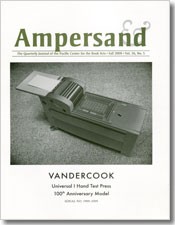
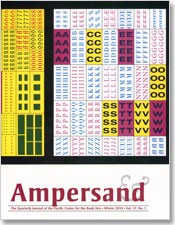
Yvonne Tsang has taken over editing the PCBA’s journal, Ampersand. The 2 latest issues are now available for purchase.
The Fall 2009 issue includes a 10:1 Scale model of the Vandercook Universal 1 Hand Test Press for you to construct as well as Johnny Carrer’s article, Translating a Complex Fine Press Edition into a Trade Edition, about the process of collaborating with Chronicle Books to produce the trade edition of his fine press book, “Pictorial Webster’s.” See the entire table of contents here.
The Winter 2010 issue includes an article on the origin of the California Job Case and Debbie Kogan’s interview with 3 book artists who make their own paper for their books. See the entire table of contents here.

Hand-drawn Online Maps

Update: the function below doesn’t appear to be working anymore and I can’t find a replacement.

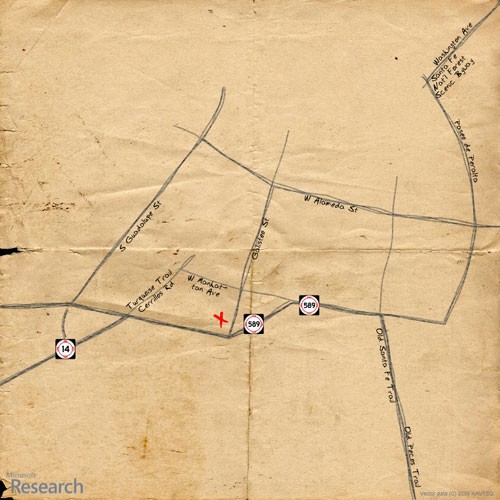
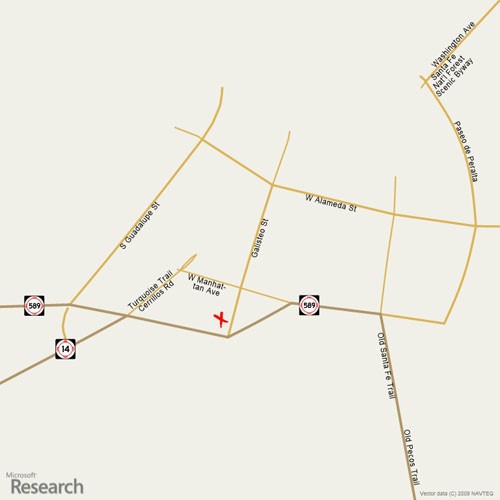
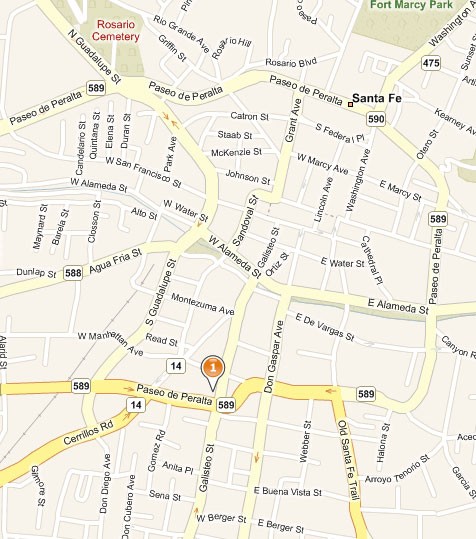
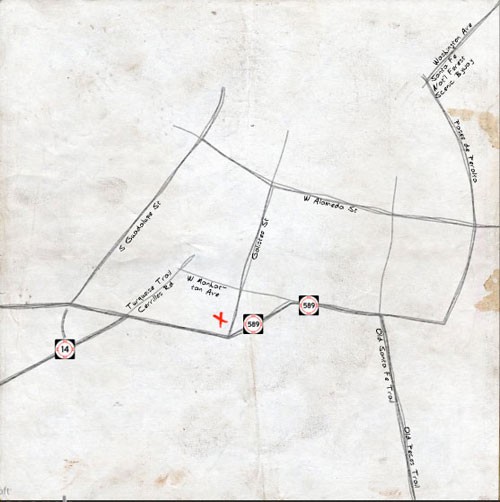
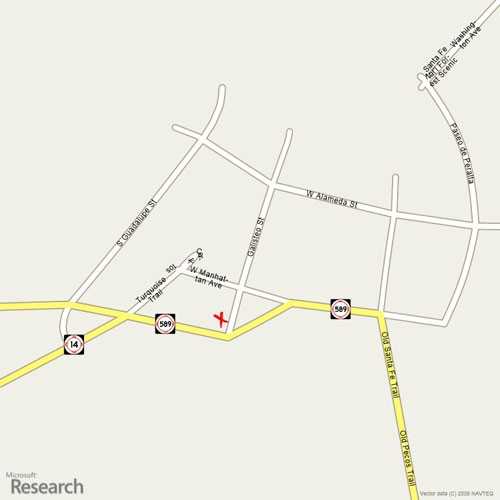
Making a map online is easy, but the results are usually awfully cluttered. Microsoft Research has a map application that takes the results of bing maps and renders it as a “sketchy”, treasure or European or American style map. The first one seems to be drawn on a soiled napkin, the second on old brown paper, complete with a red X. They’ve decluttered the maps, making them look hand-drawn and with only the major roadways indicated.
My results are below — the X marks a restaurant we’re eating at tomorrow in Santa Fe. They are certainly uncluttered, but some of the street names are uncommon (there’s no sign I’ve ever seen that calls Cerrillos Rd the Turquoise Trail, and it’s not really marked as Rt 14 until it gets out of town). Despite that, I’d certainly send one of these maps to someone before the standard online map.
To try it yourself, go to bing maps, and download the “bing maps” plugin for your browser (you’ll have to restart your browser after the download). Once you’ve done that, this link should take you to the plug in. Now click on “map apps” at the bottom of the page, and find “Destination Maps.” Once you’ve clicked on that, there are instructions to create a map….
Standard online map
Standard online map

Sketchy map
Sketchy (or napkin) map

Treasure map
Treasure map

European style map
European style map

American style map

American style map

Open Book

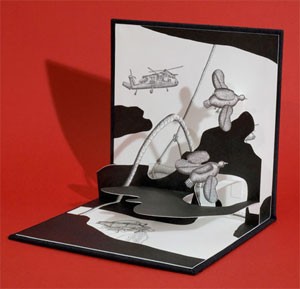
Uplift by Catarina LeitãoThe book to the left is Catarina Leitão’s Uplift, a letterpress printed pop-up book. It’s shown in the exhibition Open Book: An International Survey of Experimental Books at Eastern Michigan University. The show “investigates the role of the book in the contemporary art world” and “defines the term ‘book’ loosely as a vehicle for information that is organized into ‘sections.'” They are showing the more traditional artist’s book, like Leitão’s, sculptures made of books as well as something called Murmur Study: A live Twitter visualization and archive. I’m a bit hard-pressed to see how the sculptures fit the defintion of “vehicle for information that is organized into ‘sections'”… But see for yourself, as well as all the other work in the exhibit, here — to see the books scroll right, then click on the pictures to see more about each artist and book work. (First seen here)