Book Collecting: White Tulips

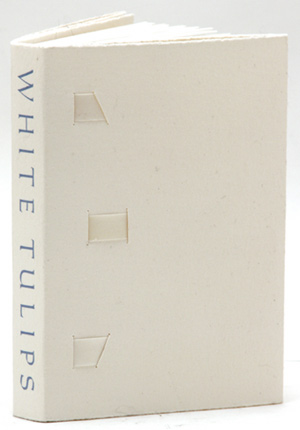
White TulipsA favorite in my collection is White Tulips, ninety-nine haiku by Ronald Baatz. Leonard Seastone of Tideline Press in upstate-New York designed the book, which he handset in Elizabeth and Carolus type and then letterpress printed on dampened, vintage Barcham Green Hayle paper. Single and fold-out pages alternate throughout the book, with the fold-out ones hiding more haiku for the reader to discover. There are 3 cream-colored strips of ribbon in the binding that make the cover even more beautiful.
Baatz writes the sort of haiku I aspire to:

shadows of branches
like dark roads
on winter’s snowy map

new clock ticks louder
than the old clock ever did
this for ten dollars

clothespins —
like skinny wooden birds
on the line

The Poetry Dispatch blog has written a bunch of posts about Baatz that include both haiku and longer poems. One of the posts quotes Norbet Blei on Baatz: “(he) sees the big picture in small, seemingly simple poems; publishes in obscure, small presses; appears invisible in today’s world of raucous voices. Silence. Every poem is a new awakening to an old truth we seldom find the words to say or see. His work is difficult to locate but worth the search. He lives in Mt. Tremper, NY. There he goes now…”

mountains disappear in fog
and i want to go right along
with them

And White Tulips is available from Joshua Heller.

Map shelf

Artist Ron Arad is mostly known for designing chairs, but for an exhibit this month at the Timothy Taylor Gallery in the UK he’s designed this steel bookshelf. According to this website it’s mysteriously called “Oh, the farmer & the cowman should be friends” (a line from a song from the musical Oklahoma). To give you an idea of the scale, it’s about 11-1/2 feet tall by about 19 feet wide (138-3/8 x 224-5/8 x 15-7/8″ or 351 x 570 x 40 cm).

Oh, the farmer & the cowman should be friends by Ron Arad

Edible Book Festival

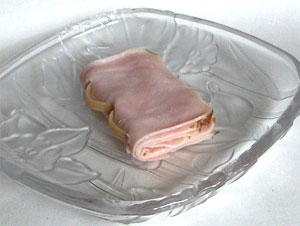
Ham PamphletThe Etsy Bookbinding Team celebrated the International Edible Book Festival by holding a virtual exhibition and competion on April 1st. The festival was started in 2000 by Judith Hoffberg; the festival website says “April 1st is the birthday of French gastronome Jean-Anthelme Brillat-Savarin (1755-1826), famous for his book Physiologie du goût, a witty meditation on food. April fools’ day is also the perfect day to eat your words and play with them as the ‘books’ are consumed on the day of the event.”
You can see all the books submitted in this Flickr pool. The winners (for best overall, best technique… ) are listed here. Pictured is Raland Kinley’s “Ham Pamphlet” or more simply known as the “Hamlet”. Materials: sliced ham, fettuccine noodle; binding: 3-hole pamphlet stitch.

micro poetry

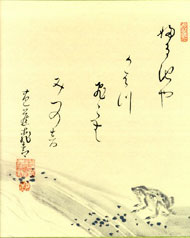
Basho’s most famous haiku might be ‘The old pond, a frog leaps in, the sound of water.’
  Probably the most well-known haiku is Basho’s poem about a frog and a pond. See Rexroth’s translation at right or 31 translations on the Bureau of Public Secrets or Chad Sweeny’s 33 translations.  

My first encounter with haiku was one rule: 3 phrases of 5, 7, 5 syllables respectively. Later I learned about the “cut” line, where the poet uses punctuation such as a dash to divide the poem into two juxtaposing or contrasting parts. As I read more about haiku in both Japanese and contemporary English and began writing my own, I gave up on the first rule — “syllable” isn’t quite what the Japanese form uses and some haiku enthusiasts say 11 syllables and a 3-5-3 syllable meter is closest to the quality of the Japanese form while others prefer the sort of “free form” haiku that I write (there’s a nice explanation of this here by Keiko Imaoka.) Some of Kenneth Rexroth’s translations of famous Japanese haiku use a free form style:

Autumn evening —
A crow on a bare branch.

An old pond —
The sound
Of a diving frog.

So probably I don’t write haiku at all, but something called “micro poetry” (see this article on Jim Murdock’s blog about short form poetry ) — but I’ll continue to be entraced by inventing 2 images in 3 lines.

April is Poetry Month

paraphernalia’s poetry brooch
Paraphernalia’s poetry brooch
Today is the first day of National Poetry Month in the US. Their website has a state-by-state calendar of events, they’ll email you a poem every day this month, and this year there’s a great poster with a quote from T. S. Eliot’s poem The Love Song of J. Alfred Prufrock: Do I dare / Disturb the universe?
While there are lots of blogs and websites devoted to poetry, one I especially like is Poem of the Week — here’s a recent post:

The House Was Quiet and the World Was Calm
Wallace Stevens

The house was quiet and the world was calm.
The reader became the book; and summer night

Was like the conscious being of the book.
The house was quiet and the world was calm.

The words were spoken as if there was no book,
Except that the reader leaned above the page,

Wanted to lean, wanted much to be
The scholar to whom his book is true, to whom

The summer night is like a perfection of thought.
The house was quiet because it had to be.

The quiet was part of the meaning, part of the mind:
The access of perfection to the page.

And the world was calm. The truth in a calm world,
In which there is no other meaning, itself

Is calm, itself is summer and night, itself
Is the reader leaning late and reading there.