A Young Mad Scientist’s First Alphabet Blocks

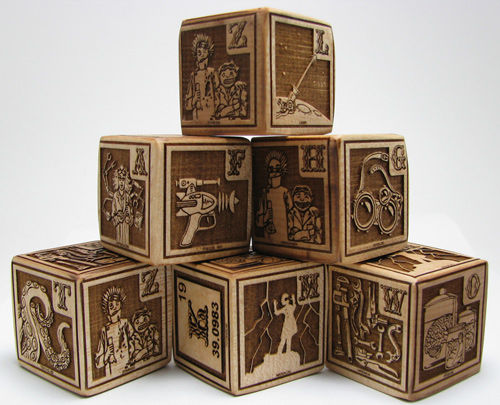
The first books I designed were ABC books, so I seem to gravitate toward anything alphabetical. These Young Mad Scientist’s ABC blocks from xylocopa are appropriately silly. They say “we have noticed that there is absolutely no training in the K-6 grades that prepares students to become mad scientists. In this competitive 21st-century world, the need for mad scientists will only increase, but the lack of basic education in primary school leaves us concerned that there will be no future students capable of leading in this illustrious field.” Here’s a list of the images (I especially like C) and then the blocks with their old-fashioned letters and illustrations.

A – Appendages
B – Bioengineering
C – Caffeine
D – Dirigible
E – Experiment
F – Freeze ray
G – Goggles
H – Henchmen
I – Invention
J – Jargon
K – Potassium
L – Laser
M – Maniacal
N – Nanotechnology
O – Organs
P – Peasants (with Pitchforks)
Q – Quantum physics
R – Robot
S – Self-experimentation
T – Tentacles
U – Underground Lair
V – Virus
W – Wrench
X – X-Ray
Y – You, the Mad Scientist
     of Tomorrow
Z – Zombies

A Young Mad Scientist’s First Alphabet Blocks

Book Collecting: Conch

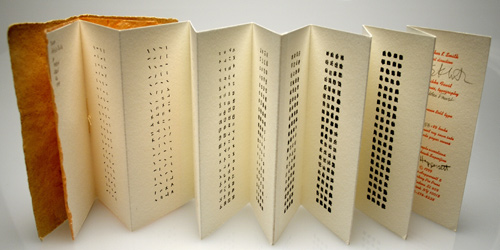
Conch by Susan Happersett

My poem-books A Word on Statistics and PI came out of a year-long class I took at the San Francisco Center for the Book in 2001-2002 with Emily McVarish and Steve Woodall. My idea was to incorporate my love of numbers into an artist’s book and I spent a fair amount of time looking at how other artists used math and number systems in their work.
One day Steve very excitedly handed me a box of 4 books called “Book of Growth” by Susan Happersett. Each one was a riff on the correlation between plant growth and the Fibonacci Sequence (1,1,2,3,5,8,13,21,34,…). The books use a visual language of grids composed of marks increasing (and sometimes decreasing) in Fibonacci progression (1 line, 2 lines, 3 lines, 5 lines) that represent the growth and decay patterns of sunflowers (bloemen), conch shells, leaves and twigs. While all the books use a similar abstract representation of the sequence, each one has different colors and paper and textures. I was just starting to buy artist’s books, and wasn’t sure what I was doing yet, so I got just one of them — Conch (that’s it above). The brittle pink-tinted handmade cover paper reminds me of shells. The books were letterpress printed and hand-bound at Purgatory Pie Press. You can buy the set through Vamp & Tramp (scroll down to the bottom of the page) or singly through Purgatory Pie.
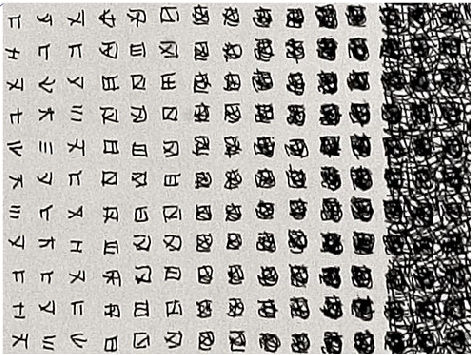
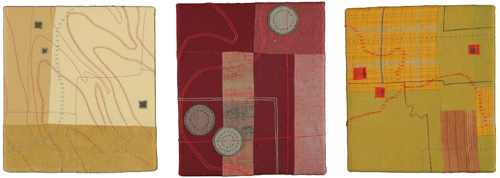
To get a better idea of the marks, here’s a detail from Happersett’s 2005 drawing “Split Tree”. It shows a progression from 3 to 5 to 8 to 13 to 21 marks per grid box.

Detail of Susan Happersett’s ‘Split Tree’ 2005

My Brain Has Always Governed My Heart

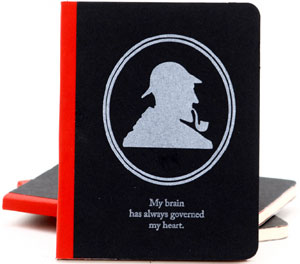
Sherlock Holmes notebooksThis year marks the 150th birthday of Arthur Conan Doyle, the man who gave us Sherlock Holmes. To celebrate I’ve designed a blank notebook with a Holmes theme. First I asked my friend Glen, expert in all things Sherlock, for some quotes I might use along with the portrait. He suggested

My brain has always governed my heart

and

I am glad of all details, whether they seem to you to be relevant or not

The first is from The Sign of Four and the second from The Adventure of the Copper Beeches.
I letterpress printed the covers and bound the books using a perfect (glued) binding. I really like the zippy red spine paper as a contrast to the black & white cover (I also used the red paper for endsheets). They are 4-1/4″ x 5-1/2″, with at least 100 blank pages for writing, sketching, or note taking. For sale here.

Macclesfield Alphabet Book

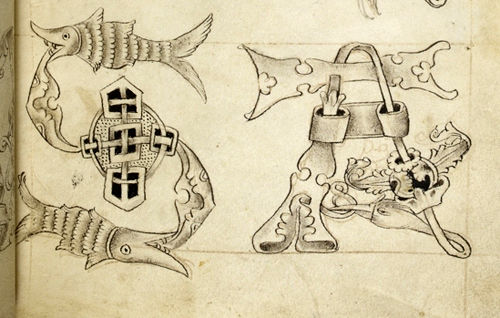
Detail from Macclesfield Alphabet Book

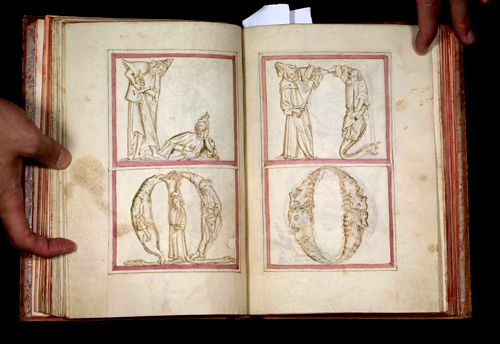
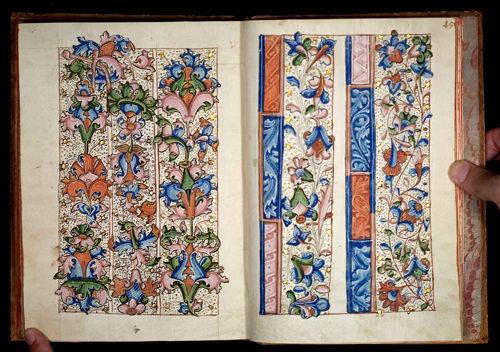
The Medieval ancestors of today’s graphic designers created ‘model’ or ‘pattern’ books to show their work to potential clients. Only a handful survive and the British Library is currently raising money to acquire an example of “outstanding significance” — the so-called Macclesfield Alphabet Book, a book that has been in the Earls of Macclesfield library since the 1750s. Below are a few more pictures, and go here to see even more.

Macclesfield Alphabet Book

Macclesfield Alphabet Book