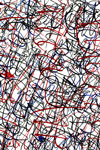
 There was a post the other day on the Book Arts email list about David Esslemont’s book My Fellow Citizens, a series of calligrams — a printed text where the typeface or the layout has a special significance — to illustrate President Obama’s inaugural address. Esslemont analyzed the word frequency in the speech, then used various ink colors and text sizes to weight the words — words used most often (nation — 11 times, new — 11 times, America — 10 times ) are large and red, the next frequency groupings are drawn in smaller blue letters and finally black ink is used for all the rest. To the left is a detail of one calligram.
 This got me thinking about word clouds — a computer generated visual depiction of a text — that use font size and color to depict the frequency of words in a given text. I’ve seen “tag clouds” on lots of blogs, the idea is to give a quick summary of that particular blog. As luck would have it, that same day I visited the blog of a friend of my Mom’s, with a link to Wordle — a site that generates a word cloud from text you provide. I found the text of Obama’s speech and got this cloud:
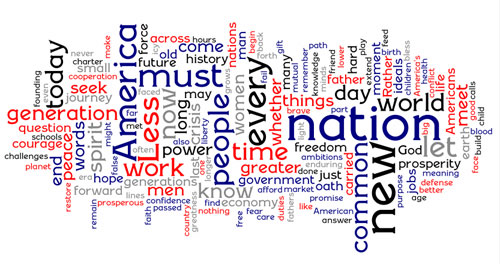
Apparently word clouds have been used a lot to look at speeches — this blog has a post called “Word Cloud Analysis of Obama’s Inaugural Speech Compared to Bush, Clinton, Reagan, Lincoln’s.” (My most glaring observation looking at them is that Bush used the word “Freedom” in his speech an enormous number of times!)
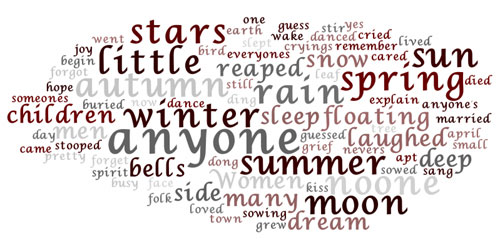
I wonder if the clouds would be useful to understand poetry? On Wordle, someone made and posted a cloud of e.e. cummings “anyone lived in a pretty how town” — cloud below followed by text of the poem. Doesn’t help me, maybe because cummings’ word play is lost (“he sang his didn’t he danced his did”) but then again it’s only one example… Let me know what you discover with them!
anyone lived in a pretty how town
(with up so floating many bells down)
spring summer autumn winter
he sang his didn’t he danced his did.
Women and men (both little and small)
cared for anyone not at all
they sowed their isn’t they reaped their same
sun moon stars rain
children guessed (but only a few
and down they forgot as up they grew
autumn winter spring summer)
that noone loved him more by more
when by now and tree by leaf
she laughed his joy she cried his grief
bird by snow and stir by still
anyone’s any was all to her
someones married their everyones
laughed their cryings and did their dance
(sleep wake hope and then)they
said their nevers they slept their dream
stars rain sun moon
(and only the snow can begin to explain
how children are apt to forget to remember
with up so floating many bells down)
one day anyone died i guess
(and noone stooped to kiss his face)
busy folk buried them side by side
little by little and was by was
all by all and deep by deep
and more by more they dream their sleep
noone and anyone earth by april
with by spirit and if by yes.
Women and men (both dong and ding)
summer autumn winter spring
reaped their sowing and went their came
sun moon stars rain
— e. e. cummings

 In this post, I wrote about the new law in the US that required, after Feb 10, 2009, that all children’s products sold in the US must be certified they meet specific lead levels. As written, the law includes books, and is retroactive, so existing and used books would also need to be tested and certified. There was lots of confusion and concern from libraries, thrift stores, publishers and non-profits about how exactly the law effects them (would libraries need to close their childrens’ rooms?)