Letterpress Print Exchange

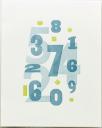
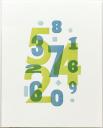
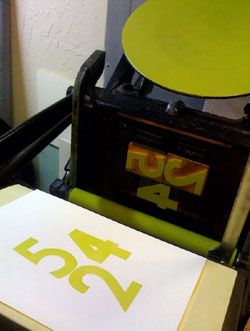
Last December, Kelly Moran organized a letterpress print exchange between sellers on Etsy. Over 40 people signed up and the prints are due by March 15. I started mine last week — I haven’t made a wood type collage since last summer, so it was fun to plan out the colors and go through my wood type drawer choosing the blocks to use. While I was at it, I decided to do 2 designs, one 8×10 the other 5×7, in several different colorways. Below are 2 of the resulting prints — the one on the far left is for the print swap. The photo to the right shows the set-up for the print run for the first color of the print below right (it looks awfully yellow but is actually green!). Next up is figuring out the titles (that’s probably the best part of the entire process!), numbering and signing them, and finally shipping the swap prints to Kelly.

Print for Letterpress ExchangeAnother wood type collage

Press setup

Yardwork’s Bookcloth

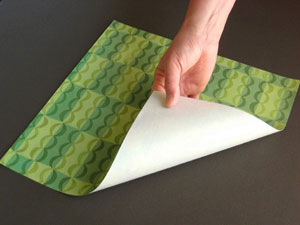
Yardwork BookclothSusan Scott designs and prints her own fabric then turns it into bookcloth that she sells in her Yardwork Etsy shop. (She also sells books covered with her fabric.) In her Etsy profile, she explains her printing process and says this about making bookcloth:

To begin with, the time-honored glue of choice, wheat paste, must be mixed with water and cooked either in a microwave or on the stove. The printed, dyed and washed fabric is then stretched out onto a pane of glass. A thin layer of acid-free wheat paste is brushed over the damp fabric and a very thin sheet of Japanese Mulberry paper, which is cut larger than the fabric, is carefully placed over it. The paper becomes very wet from the wheat paste and can be rolled onto the fabric with a rubber brayer. I allow the fabric and paper to dry on the window frame for around 24 hours. When completely dry, the paper edges are cut away to reveal the fabric edge. The paper and fabric is then easily pulled away from the glass as one combined piece of bookcloth.

Military Mapmaking Kit

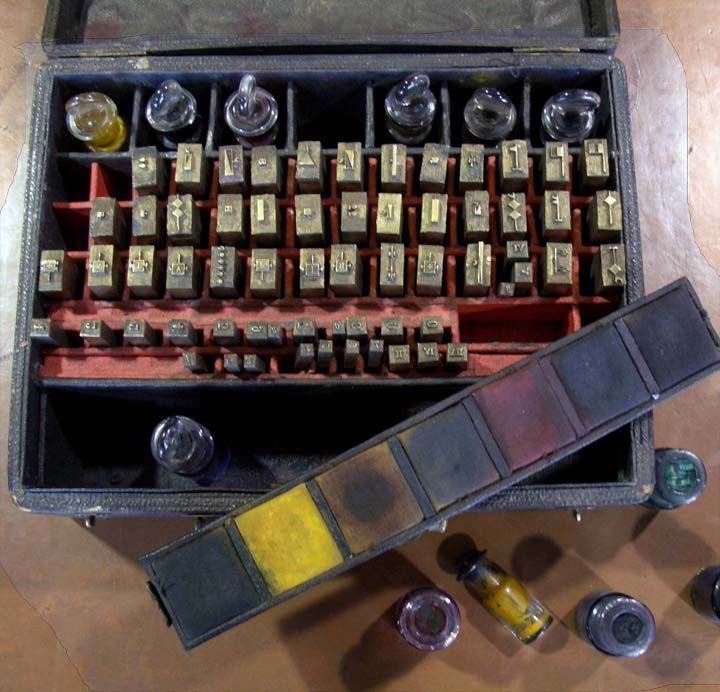
Military Mapmaking KitMegan, a fellow letterpress printer and instructor, sent me a link about the intriguing “military map printing case” on the left, recently acquired at Princeton University (click on the photo to see an enlargement and the symbols on the brass stamps). The post didn’t offer many details:

This mapmaker’s printing case was designed to be used by a government sponsored cartographer when working in the field around the 1860s. The buckram-covered case holds 63 brass sorts with a selection of numbers and military symbols. There is an ink pad and twelve glass bottles of ink, some with the label of the Paris manufacturer Dagron & Compagnie.

So I poked around a bit, and found a shop specializing in antique maps in the UK selling pretty much the same case (for a mere £2200 or about $3200 US). There’s a bit more information there about how a mapmaker might have used the brass stamps:

We presume the brass printing blocks would have been set in a hand-held “form” and “stamped” onto pre-existing printed topographic maps so that military officials could more clearly trace and interpret manouevres and strategies.

Math Clocks

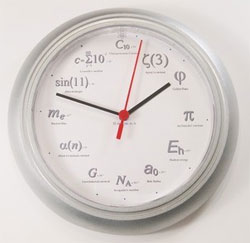
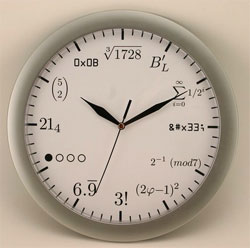
I’m just a sucker for weird symbols and numbers. The left clock has an explanation of each expression underneath it. “3” is represented by π (3.14…) and a blue dot on the outside of the circle where the numerical value would fall (just below the 3 position). The other expressions are the same way (for example “6” is Avogadro’s number, which is 6.0221415 × 10^23.) The right one isn’t as clever about the expressions and placement, but I think I like the symbols just as well!

Geeky math clock math clock