Iraq Paper Scissors

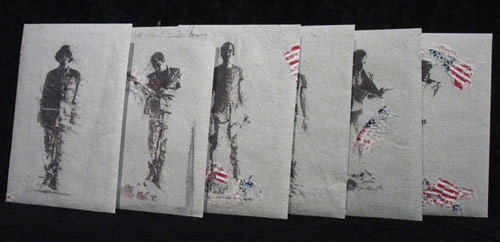
Envelopes made by Combat Paper

Last summer, Drew Matott of the People’s Republic of Paper gave a class in 17th century paper making at the San Francisco Center for the Book. My friend Pam met Drew while he was in SF, and later met him at Columbia College in Chicago to learn to make paper herself. She brought back with her a huge pile of the most beautiful paper — and many of us have been watching excitedly as Pam finishes the paper and puts it to use in a book she’s writing. While in Chicago, she got involved with the Combat Paper Project — a group of Iraq war veterans who have cut up their uniforms, turned them into pulp and paper, and then that paper into books of poetry, broadsides and works of art. Pam has some of the paper they’ve made — with visible bits of uniform — that is quite moving to see. Even more moving is this short documentary of the project, showing the veterans making paper and using the act of making art to transform their war experiences.
Reconstructing the Gutenburg Press

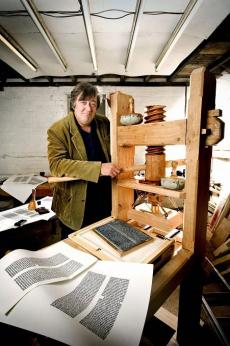
Stephen FryAs part of The Medieval Season series from the BBC, in the installment “The Machine That Made Us,” Stephen Fry travels to France and Germany on the trail of Johannes Gutenberg, the inventor of the printing press. The printing press was the world’s first mass-production machine, and Fry shows how it was at the forefront of a cultural revolution that transformed the west. Along the way Fry learns to make paper, cast type, and, best of all, reconstructs a working replica of Gutenburg’s first press. (There are no extant pictures or plans for that first press, so there’s a bit of historical detective work to figure out how the press might have been configured.) It’s a wonderful documentary, and you can watch it on Youtube as 6 10-minute videos.

A Giveaway for National Poetry Month

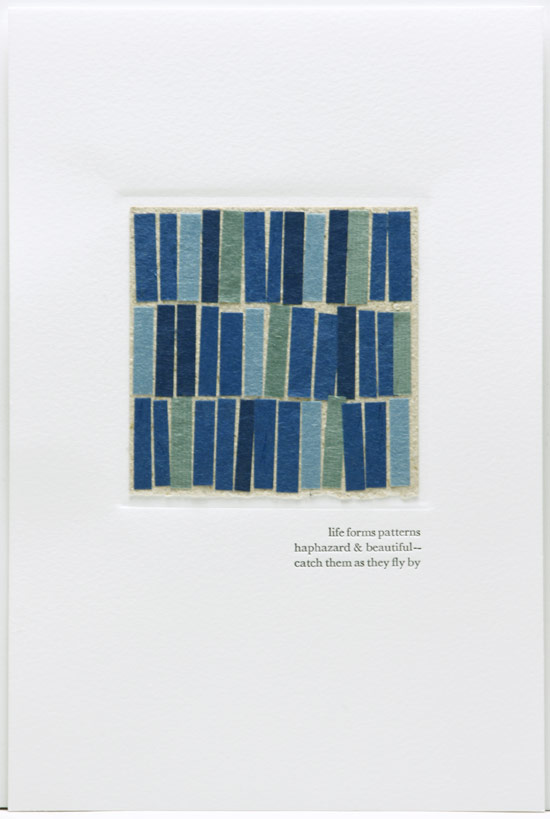
Pattern Forms no 11, detail
To celebrate National Poetry Month, I’m giving away one of my one-of-a-kind Pattern Forms broadsides. That’s a detail picture of the broadside to the left. It’s a cut paper collage with a letterpress printed original haiku beneath it. The collage is 3-1/2″ x 3-1/2″, on 6″ x 9″ paper, and sits in a hand-debossed (recessed) panel. The type is handset in Baskerville; the paper is Somerset. You can see the entire broadside here.
To win, post your favorite poem in a comment below or email it to me by April 29th. The winner will be announced on May 1st. Be sure to leave an email address where I can reach you. The winner will be selected at random from the submitted poems.
Letterpress Buckles

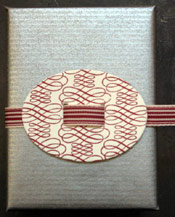
I’m a sucker for almost anything printed letterpress, especially if it isn’t the usual card or wedding invitation. Pictured to the right, to quote the seller, d.Sharp, is a “functional belt of letterpress printed paper and quality ribbon to decorate gifts. Forget impossible knots or fussy bows, simply slide over box and cinch, cut excess ribbon as desired. Reusable!” dsharp letterpress buckles

Working Closely on the Press

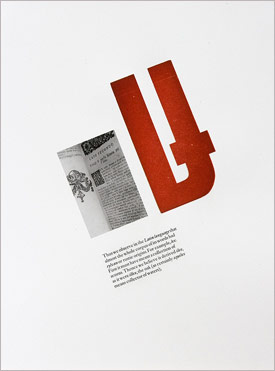
Stauffacher & Letbetter: Vico DuodecimoFor many years, Jack Stauffacher, a well-known letterpress printer and book-designer at Greenwood Press in San Francisco, has been making broadsides and prints using his small collection of assorted pieces of large wood type. Several prints he did with Dennis Letbetter for an edition in 2006 have recently been on display at San Francisco Center for the Book. In the text for the exhibit there’s a quote by Stauffacher that sums up perfectly how I feel about creating my own wood type collage prints.

“Taking these shapes, these letters, they are somehow no longer letters in the formal sense, they become more of a shape, an abstraction, and I have used them [within the page size] allotted to the portfolios in a variety of arrangements, different colors, different connections with the text and the photographs. When you work this closely on the press, you don’t have it all figured out, you do the whole thing mostly right there in the process.”

More on Stauffacher and his wood type work are here. You can see all the prints in the Vico Duodecimo portfolio, one of which is pictured above, here.